The first homepages of the brands everyone knows were small, slow and mostly about the company itself. Apple’s offered a list of countries and a page of press news, McDonald’s was a red page with one fact about hamburgers, and Netflix rented DVDs at $4 each. A few were more honest than the brands that grew out of them: thefacebook described itself as an online directory for Harvard, and YouTube’s earliest surviving homepage still had a filter for meeting people. This page shows the earliest usable copy of 26 big brands’ homepages in the Internet Archive’s Wayback Machine, from 1996 to 2006, with what each page tried to do and what the same address does now. Each screenshot was taken from the archived page and links to the capture it shows.
— Top
Old websites of big brands: what 26 first homepages looked like
Apple’s country list, Amazon’s tab bar, Google’s BETA logo, YouTube’s dating filter and Pizza Hut’s order form: the earliest archived homepage of 26 brands, what each one was for, and what it does today.

Twenty-six homepages and their earliest usable capture
| Brand | Earliest usable capture | What the homepage did | What it does today |
|---|---|---|---|
| Yahoo! | 17 Oct 1996 | A directory of the web in plain text, with a search box | News, finance and mail portal |
| Microsoft | 20 Oct 1996 | Products, support and “Where do you want to go today?” | Product tiles for Copilot, Xbox and Microsoft 365 |
| Apple | 22 Oct 1996 | A country list and press news, with no store | One product hero and an online store |
| Disney | 22 Oct 1996 | Films, books, music and online ordering | Disney+, parks and the shop |
| adidas | 23 Oct 1996 | A monthly online magazine | A shop |
| BMW | 30 Oct 1996 | A list of national sites and advice on which Netscape to use | Models, video and a configurator |
| LEGO | 9 Nov 1996 | A letter to children on a background of LEGO studs | A shop, games and a members’ club |
| McDonald’s | 10 Nov 1996 | One fact on a red page, then the Golden Arches | Ordering, deals and rewards |
| Mercedes-Benz | 10 Nov 1996 | A welcome, the star and a choice of German or English | Models, a configurator and a dealer search |
| The New York Times | 12 Nov 1996 | A registration page for the paper online | A front page behind a paywall |
| Pepsi | 19 Dec 1996 | Pepsi World, with a Shockwave game | Products and campaigns |
| Pizza Hut | 19 Dec 1996 | A pizza order form: name, address, phone | Ordering, deals and a tracker |
| Nokia | 19 Dec 1996 | A corporate site of the Nokia Group | Network infrastructure, no phones |
| Toyota | 24 Dec 1996 | A seasonal letter and a dealer locator | Build and price, local offers |
| BBC | 28 Apr 1997 | A column of buttons for TV, radio and news | News, Sport, iPlayer and Sounds |
| eBay | 14 Jun 1997 | “Auction Web”, free for buyers | A personalised marketplace |
| 2 Dec 1998 | A logo marked BETA and one search box | A logo and one search box, plus AI answers | |
| IKEA | 12 Dec 1998 | A country picker; nothing could be bought | A full online shop and room planners |
| Netflix | 17 Jan 1999 | DVD rentals at $4 each | Streaming behind a login |
| Starbucks | 17 Jan 1999 | An online store with a $249 espresso machine | Ordering and rewards, no online store |
| Amazon | 28 Aug 1999 | Tabs for books, music, video, toys and auctions | A personalised shop built around search |
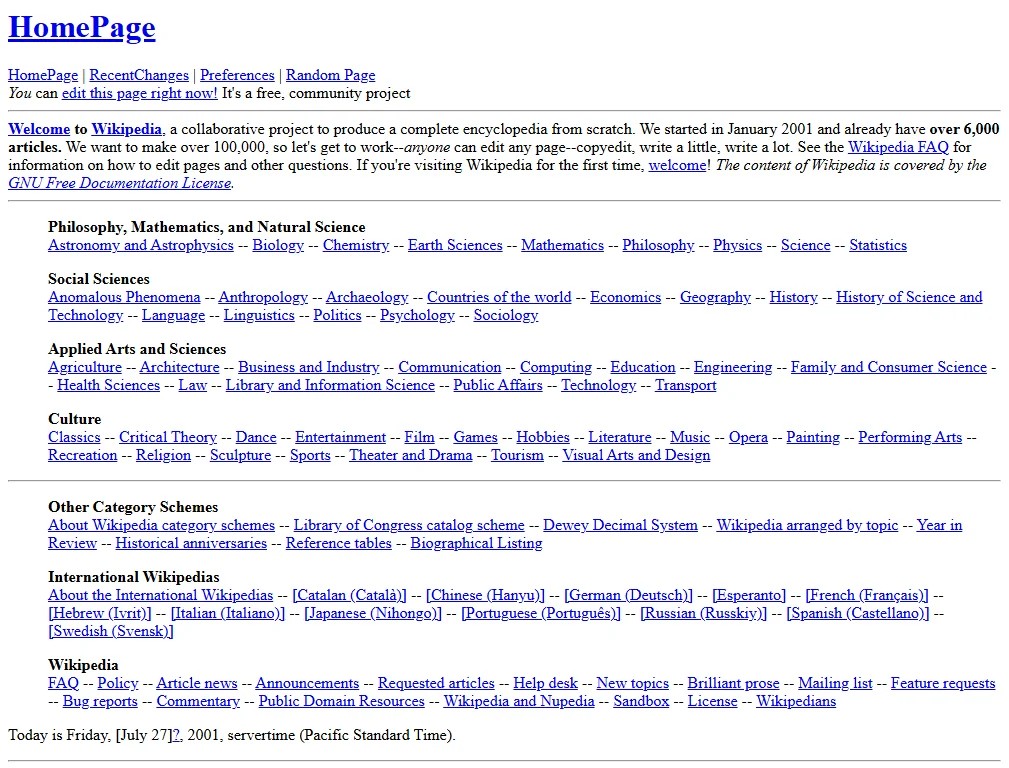
| Wikipedia | 27 Jul 2001 | 6,000 articles and a request to edit | About 7 million English articles |
| thefacebook | 12 Feb 2004 | An online directory for Harvard students | A feed of video, groups and ads |
| YouTube | 28 Apr 2005 | Video uploads and a dating-style filter | Video recommendations and Shorts |
| 30 Sep 2006 | Status updates sent from a phone by text message | x.com | |
| Spotify | 8 Nov 2006 | A logo and a box for your email address | The web player and Premium plans |
Dates are the earliest copy in the Wayback Machine that shows a real homepage, not the launch date: the Archive began collecting in 1996, so sites launched in 1994 and 1995 appear later than they went online. “Today” describes each homepage as of November 2026.
Why a brand’s first website is usually gone
Most of these companies cannot show you their first homepage either. The web grew from about 130 websites in June 1993 to around 100,000 in January 1996, according to Matthew Gray of MIT, who counted them with an early web crawler, and almost nobody kept copies. The Internet Archive began collecting websites in 1996 and opened its Wayback Machine to the public on 24 October 2001. Anything that went online before 1996 and changed before the Archive’s first visit is lost, unless the company saved it.
Few did. Microsoft’s first homepage went online in 1994, and for the site’s twentieth anniversary in 2014 the company had it rebuilt, because the original was gone; the reconstruction is still on microsoft.com. Amazon’s launch page from 1995 and the first versions of Yahoo! from 1994 survive only as screenshots the companies or the press kept. So the dates on this page are the earliest copy in the Archive that shows a real homepage, which for some brands is three or four years after launch.
The pages that did survive show what a homepage was for before anyone knew. Most explain who the company is, list its countries, and ask the visitor to click an image to go further. Only a few sell anything. Our guide to the oldest websites still online covers the handful of 1990s pages that are still live; this one is about the brands whose first sites were replaced.
Search and portals: Yahoo!, Google, Microsoft and Wikipedia
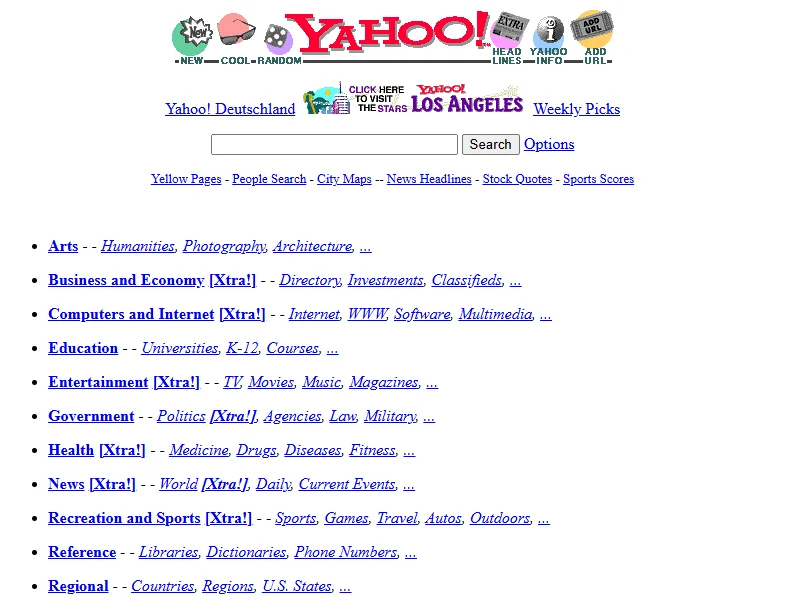
Yahoo! started in January 1994 as “Jerry and David’s Guide to the World Wide Web”, a list of links kept by two Stanford students, Jerry Yang and David Filo. The earliest copy in the Archive, from October 1996, is still that list: a search box over two columns of plain-text categories, from Arts and Business and Economy to Health and News, with only two images on the page.
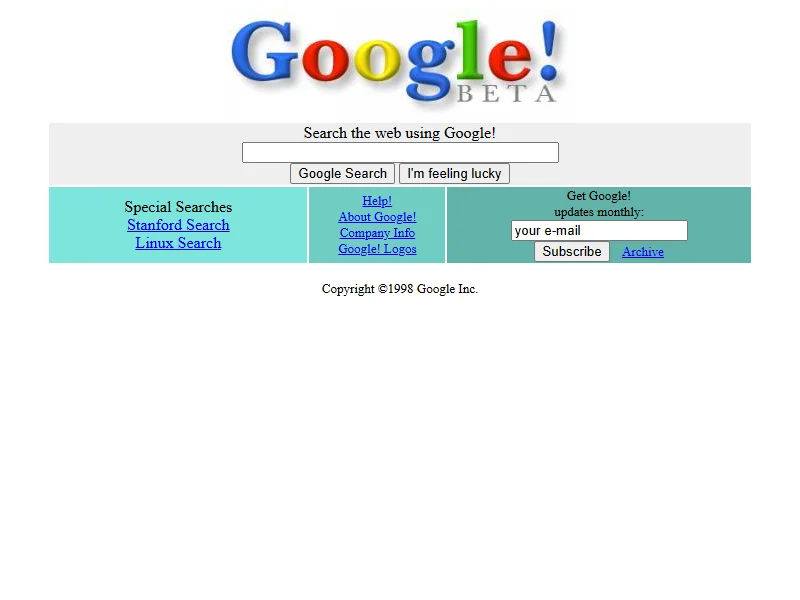
Google’s first homepage was even plainer. In November 1998 the search engine still ran at google.stanford.edu, under a copyright line for Stanford University, and said its index held about 25 million pages, “soon to be much bigger”. By 2 December 1998 google.com showed a logo with an exclamation mark and the word BETA, a search box, an “I’m feeling lucky” button and an offer to send Google news by email every month. It is the only homepage in this list whose idea has not changed: a logo and one box. Google still shows its results in that 1998 style if you search for “google in 1998”, one of the Google easter eggs that still work.
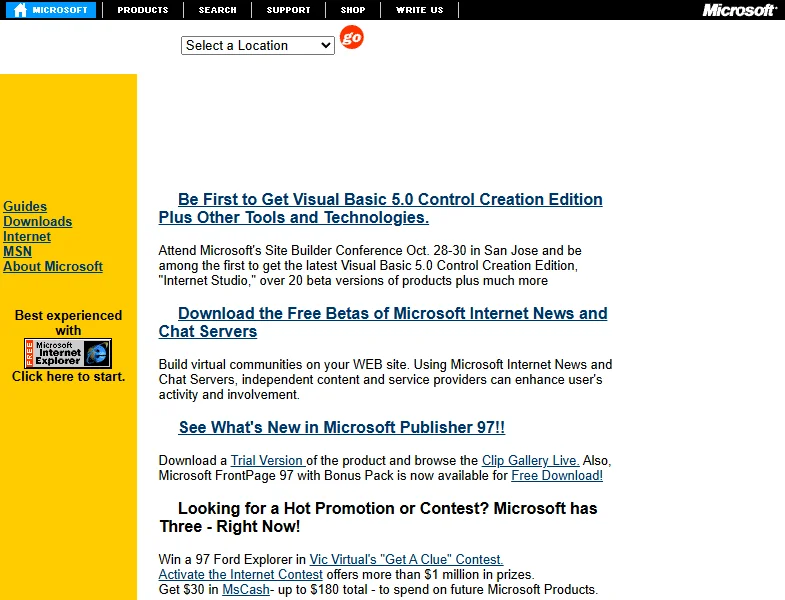
Microsoft’s homepage in October 1996 carried the slogan of its advertising campaign, “Where do you want to go today?”, a drop-down to choose a country, and a button saying the site was best experienced with Internet Explorer. Wikipedia arrived later, and its earliest copy from July 2001 is a page of black links on white that says it started in January, already has over 6,000 articles and wants to reach 100,000. English Wikipedia now has about 7 million.

Yahoo!, 1996: a directory of the web in two columns of text.Internet Archive, 17 Oct 1996 
Google at Stanford, November 1998: “soon to be much bigger”.Internet Archive, 11 Nov 1998 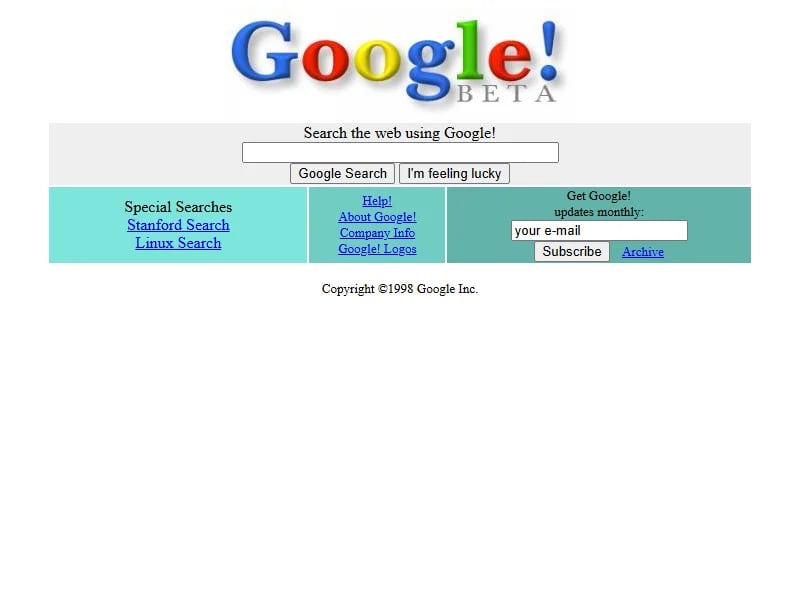
google.com, December 1998: a logo, BETA and one box.Internet Archive, 2 Dec 1998 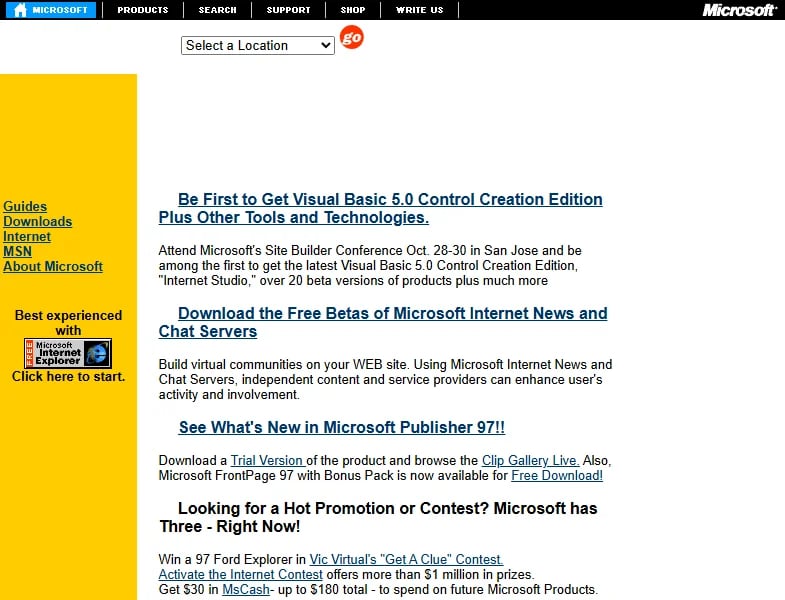
Microsoft, 1996: “Where do you want to go today?”Internet Archive, 20 Oct 1996 
Wikipedia, 2001: over 6,000 articles, aiming for 100,000.Internet Archive, 27 Jul 2001

The shops: Amazon, eBay, Netflix, Pizza Hut and Starbucks
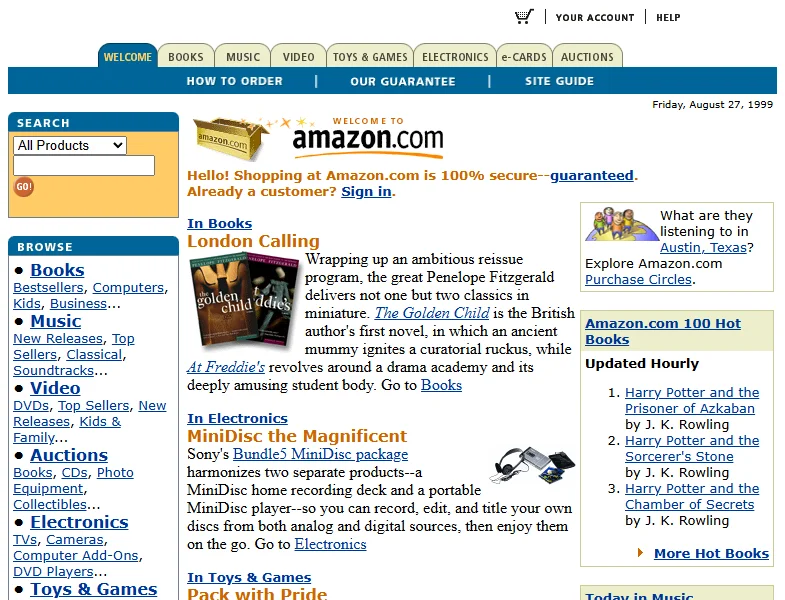
Amazon opened on 16 July 1995 as an online bookshop and sold to all 50 US states and 45 other countries in its first two months. The Archive has no usable copy until August 1999, because its earlier visits were redirected to session addresses that were never saved. By then the page was titled “Earth’s Biggest Selection”, with tabs for books, music, video, toys and games, electronics and auctions, all as blue links on white.
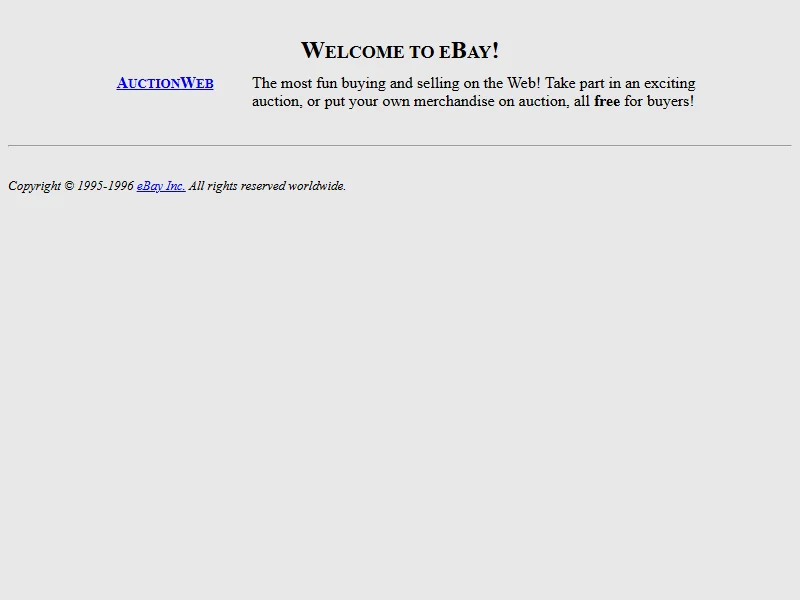
eBay began in September 1995 as AuctionWeb, a section of Pierre Omidyar’s personal site, and its first sale was a broken laser pointer for $14.83. The copy from June 1997 still uses both names on a flat grey page: “Welcome to eBay! Auction Web: the most fun buying and selling on the Web.” Netflix opened in April 1998 with about 925 films, rented one at a time; in January 1999 its homepage advertised over 2,600 DVDs, rentals at $4.00 each, and an arrangement to send buyers to Amazon.
The oldest working shop in this list is a form. Pizza Hut and The Santa Cruz Operation announced PizzaNet in August 1994 as a pilot in Santa Cruz, California, and Pizza Hut’s homepage in December 1996 is still that page: a grey background, two logos and fields for a name, a street address and a phone number. Pizza Hut calls it the first online purchase, but a Sting CD paid for by card on NetMarket on 11 August 1994 has a rival claim, and PizzaNet customers paid the driver on delivery, so it is safest to call it one of the first things ever ordered online. The other firsts of that year, from the first banner ad to the first commercial spam, are in internet marketing firsts. Starbucks opened its online store for Christmas 1998, sold a $249 espresso machine on its homepage in January 1999, and closed the store in 2017.
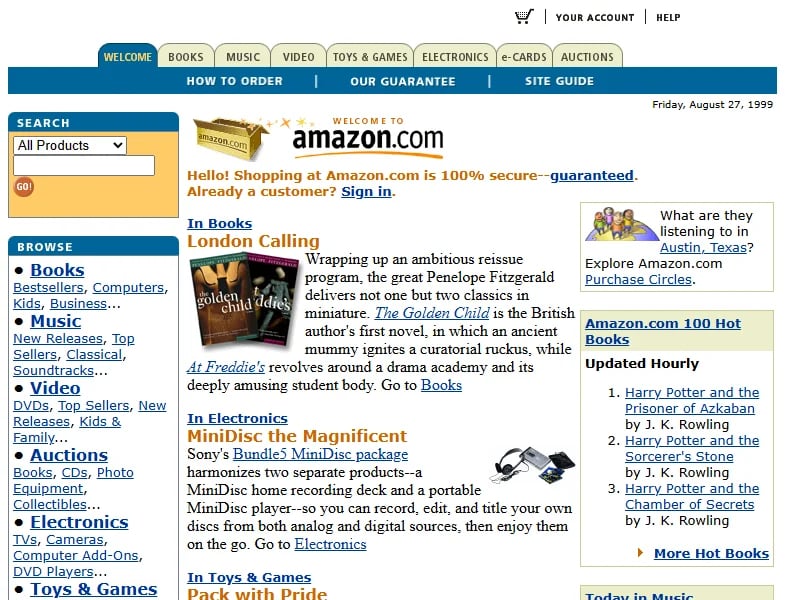
Amazon, 1999: “Earth’s Biggest Selection”.Internet Archive, 28 Aug 1999 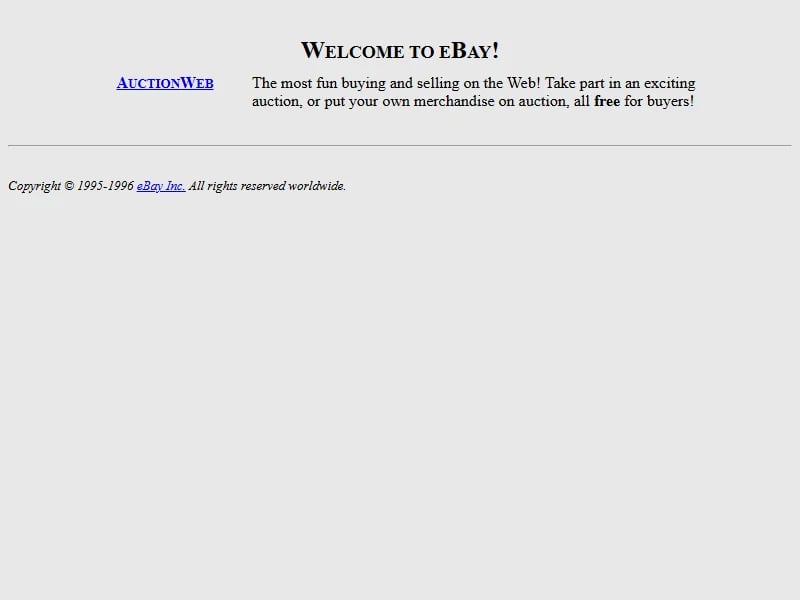
eBay, 1997: still called AuctionWeb too.Internet Archive, 14 Jun 1997 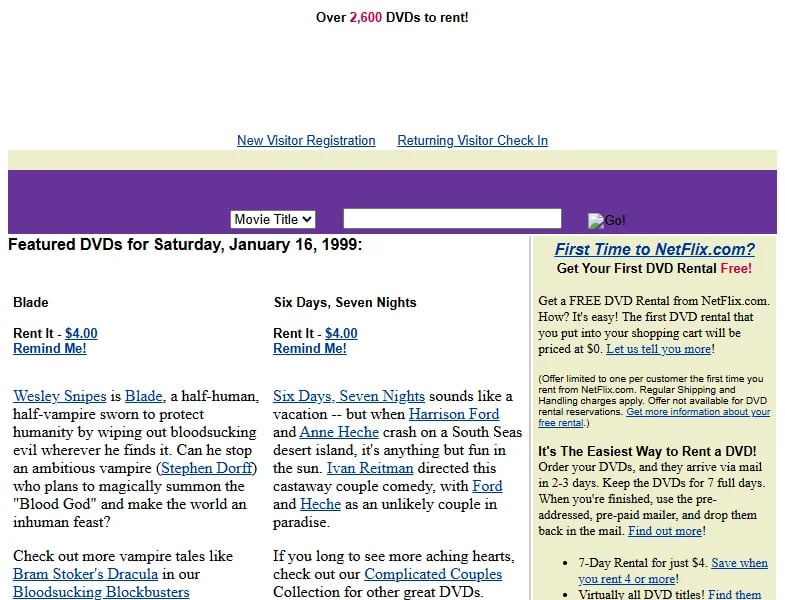
Netflix, 1999: DVD rentals at $4.00 each.Internet Archive, 17 Jan 1999 
Pizza Hut, 1996: the PizzaNet order form.Internet Archive, 19 Dec 1996


Social sites: thefacebook, YouTube, Twitter and Spotify
The social sites of the 2000s started with a sentence about what they were. thefacebook went online on 4 February 2004, and the copy from eight days later describes the site as “an online directory that connects people through social networks at colleges”, open only to Harvard. It lists four things you can do, including “See a visualization of your social network”, and ends with “a Mark Zuckerberg production”. The company bought facebook.com in 2005 for $200,000.
YouTube’s earliest copy, from 28 April 2005, five days after the first video was uploaded, is the best surprise in the Archive. Under the log-in box is a row of drop-down menus that reads “I’m a Male seeking Everyone between 18 and 45”, a filter left over from the founders’ first idea of a video dating site.
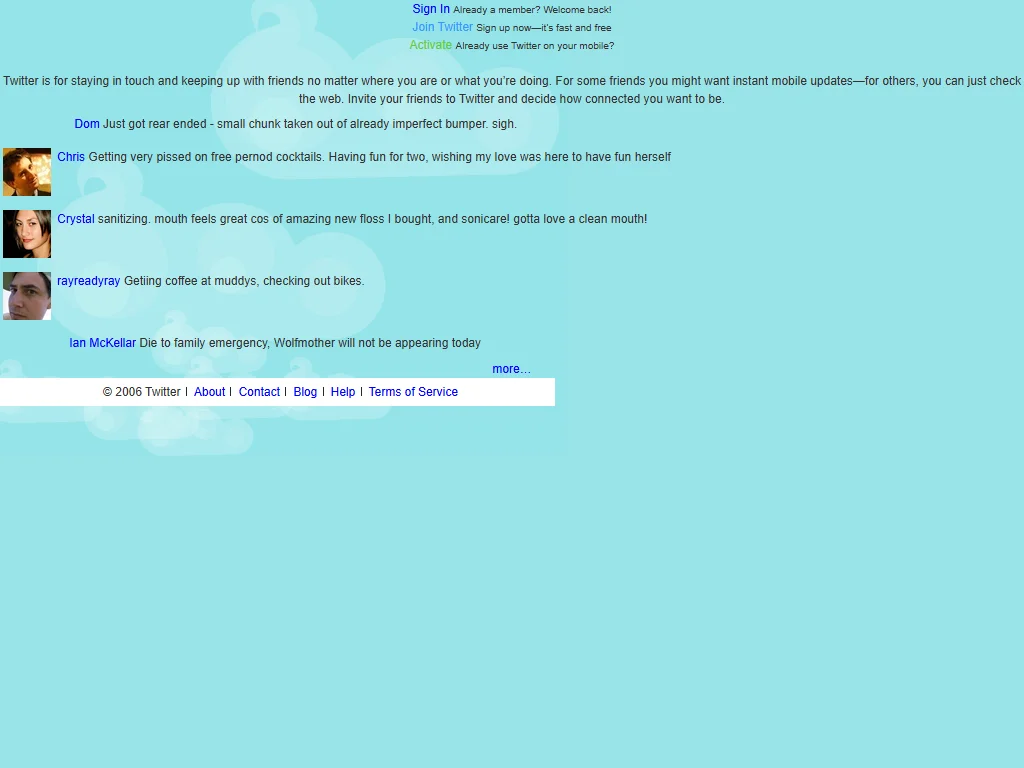
Twitter’s homepage in September 2006 explained a service built for text messages: sign up, then “Activate: already use Twitter on your mobile?”, above a list of real updates from users. Spotify’s first page, from November 2006, was a logo and a box for your email address “to be informed when exciting stuff happens”; the service launched almost two years later, in October 2008.
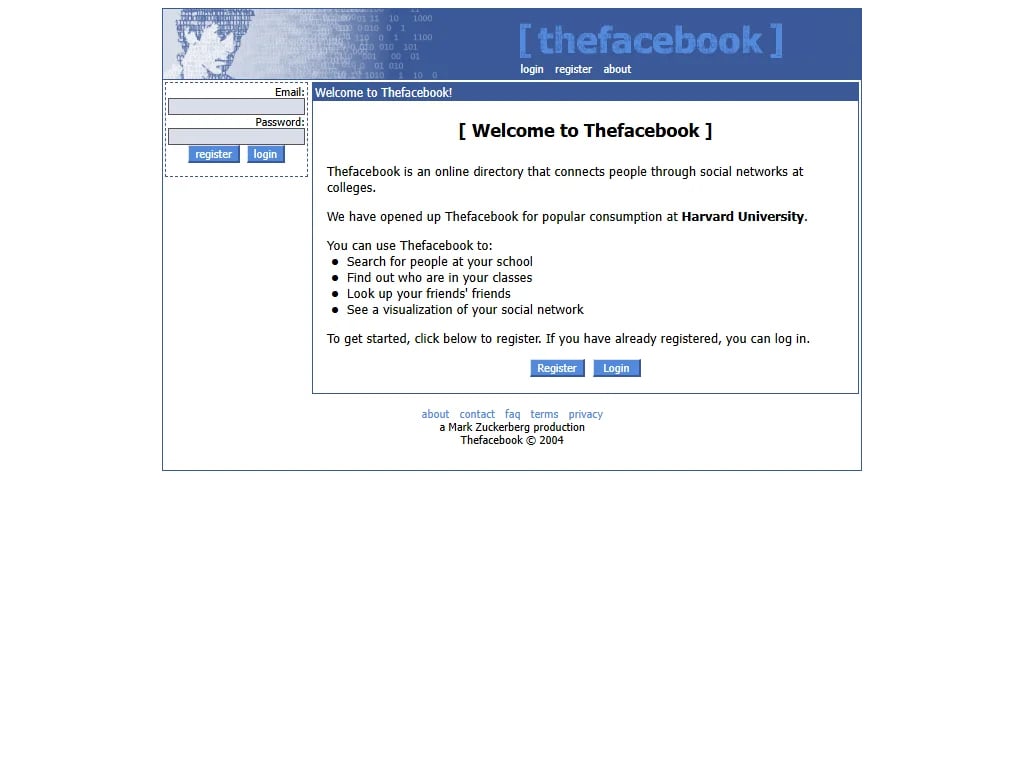
thefacebook, 2004: an online directory for Harvard.Internet Archive, 12 Feb 2004 
YouTube, 2005: the dating filter under the login box. The grey area held a Flash player.Internet Archive, 28 Apr 2005 
Twitter, 2006: built for text messages.Internet Archive, 30 Sep 2006


Brands with nothing to sell online: Apple, Pepsi, McDonald’s, LEGO, Disney and adidas
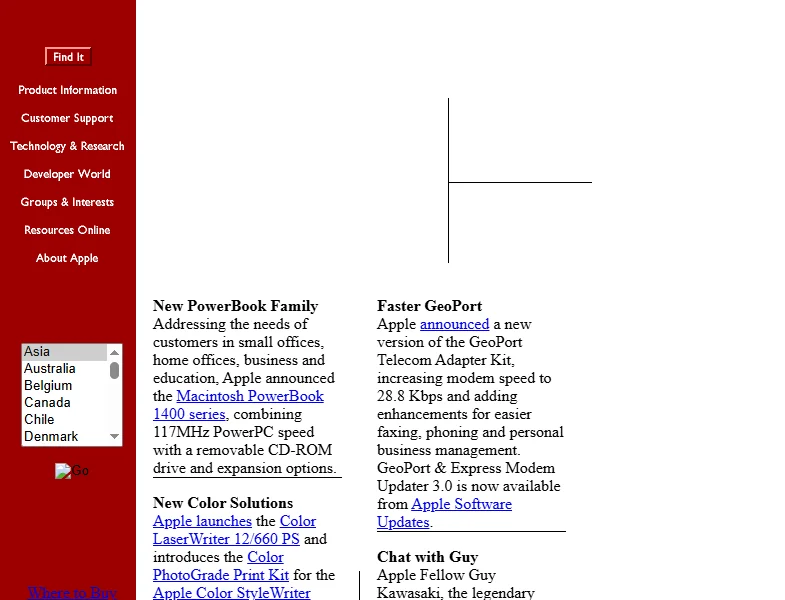
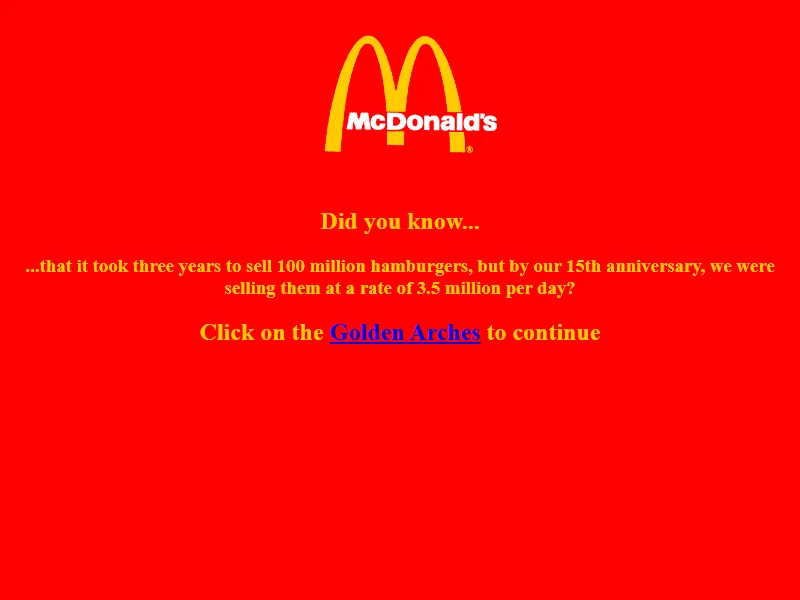
In 1996 a brand’s website was an advertisement you had to find. Apple’s, in October 1996, was a list of countries, a row of navigation images and news about the PowerBook 1400, with a 117 MHz processor and a removable CD-ROM drive; there was no store. McDonald’s homepage was a red page with yellow text saying it had taken three years to sell 100 million hamburgers, and that by the fifteenth anniversary they were selling 3.5 million a day. “Click on the Golden Arches to continue.”
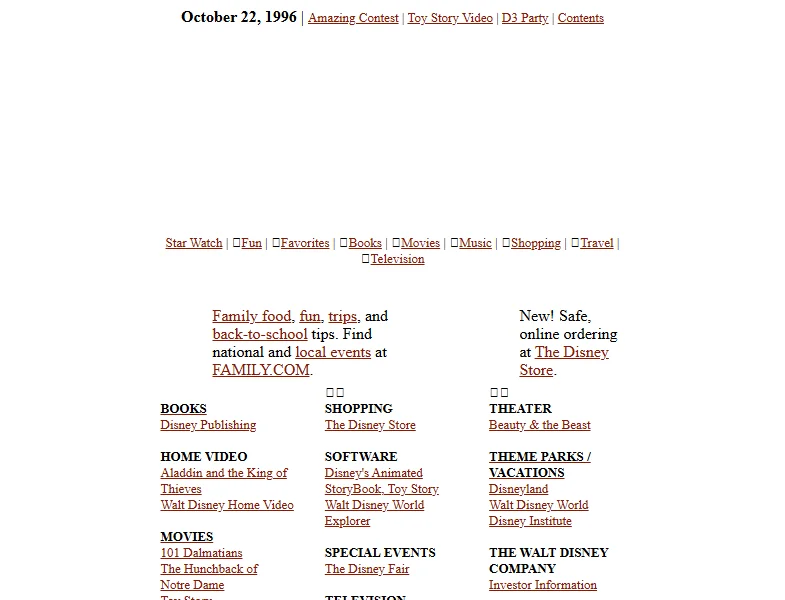
Pepsi World, on a black background with a green mesh pattern, asked for the Shockwave plug-in, and a review that year said a visitor needed Internet Explorer 3.0, Shockwave and RealAudio to see all of it. LEGO.com, live since March 1996, tiled its background with LEGO studs and opened with a letter to children: “You are simply our V.I.P., our most important person.” Disney’s homepage, launched the same year, listed Toy Story, 101 Dalmatians and The Hunchback of Notre Dame and offered “safe, online ordering” at the Disney Store.
adidas did not have a homepage in the modern sense: it had a magazine. The copy from October 1996 is “adidas webZine, Issue 6: Feet You Wear”, named after that year’s shoe technology, with a scrolling headline and icons for help, next month’s issue, jobs and financial reports.
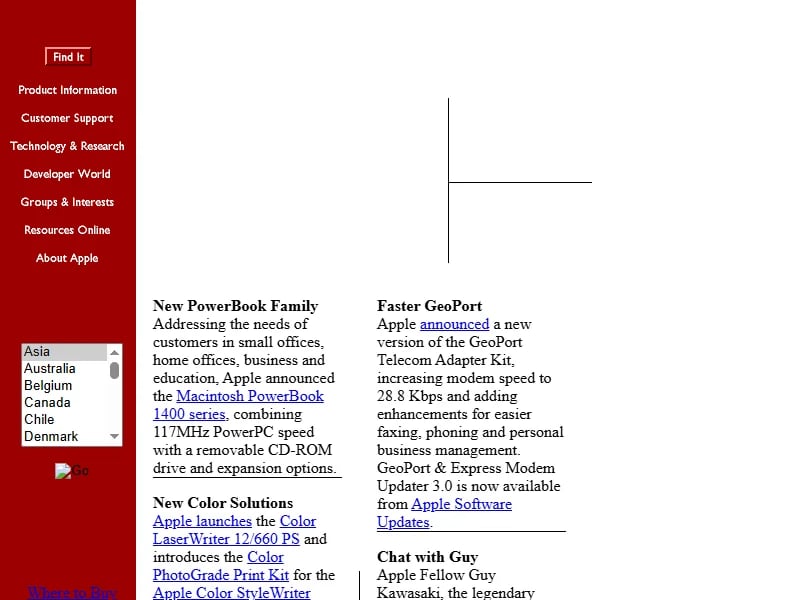
Apple, 1996: news and a country list, no store.Internet Archive, 22 Oct 1996 
Pepsi, 1996: Pepsi World, Shockwave required.Internet Archive, 19 Dec 1996 
McDonald’s, 1996: one fact, then click the arches.Internet Archive, 10 Nov 1996 
LEGO, 1996: a letter to children on LEGO studs.Internet Archive, 9 Nov 1996 
Disney, 1996: films, books and online ordering.Internet Archive, 22 Oct 1996 
adidas, 1996: a monthly magazine instead of a homepage.Internet Archive, 23 Oct 1996



Cars, furniture and news: Toyota, BMW, Mercedes-Benz, IKEA, Nokia, the BBC and The New York Times
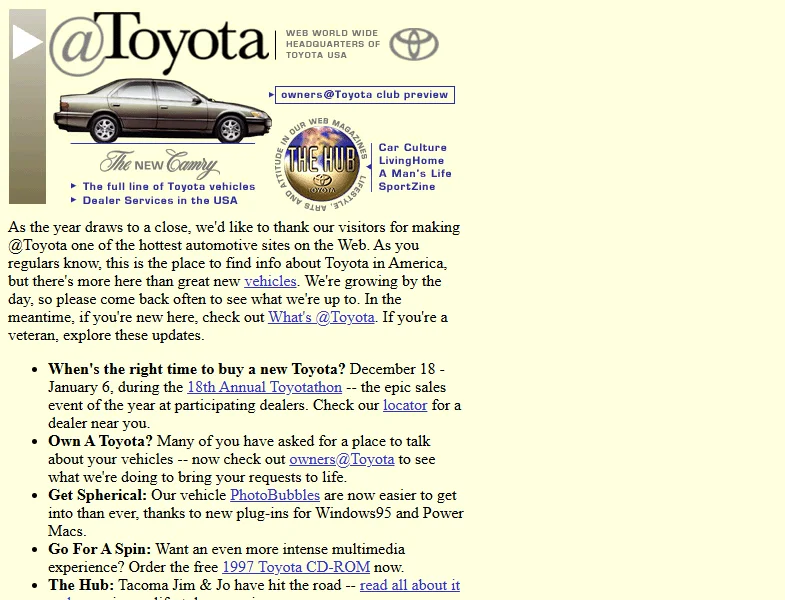
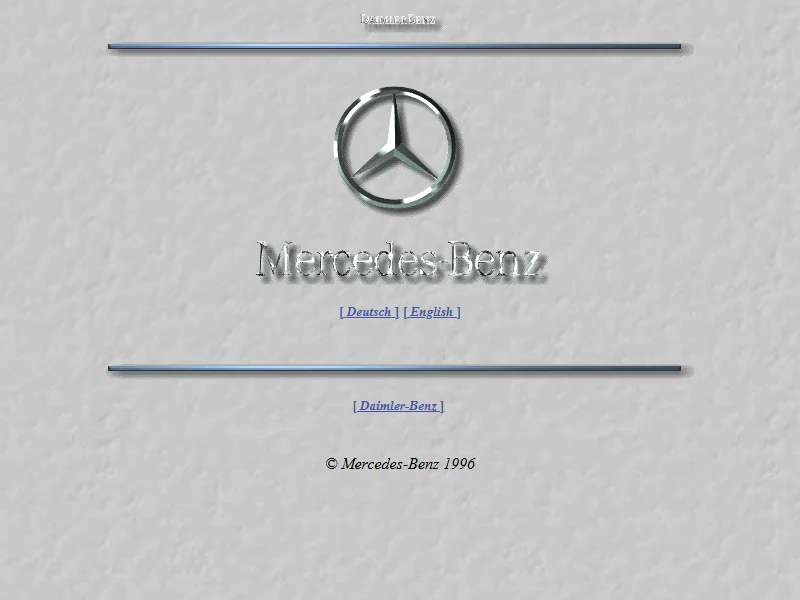
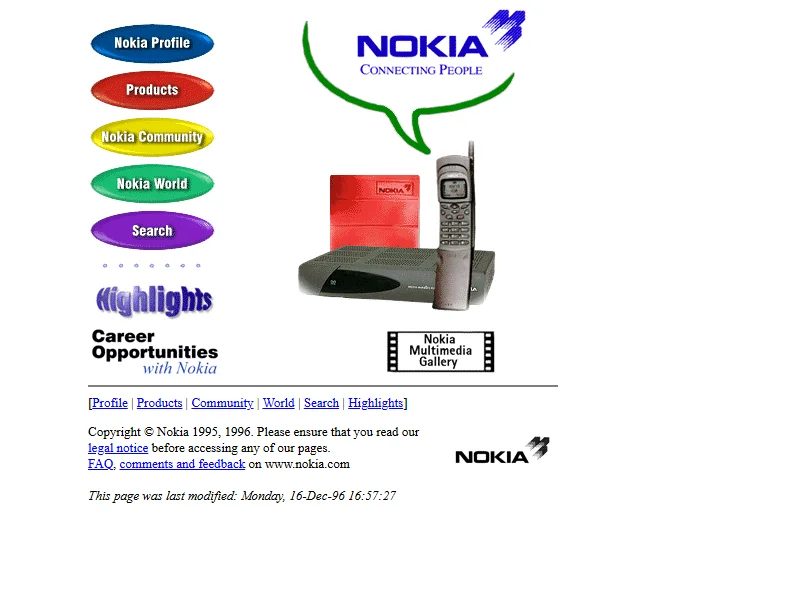
Car makers wrote letters. Toyota’s homepage on Christmas Eve 1996 thanked visitors for making “@Toyota” one of the hottest automotive sites on the web and announced the 18th Toyotathon sale. BMW’s, from October 1996, introduced itself as “the World Wide Web server of BMW AG, Munich”, listed its national sites and asked visitors to use Netscape 1.1 on a Mac or 1.2 on Windows. Mercedes-Benz’s page from November 1996 was titled “We are happy to welcome you” and held little more than the star, a choice of Deutsch or English and a link to its parent company, Daimler-Benz. Nokia’s page from December 1996 says it was last modified on Monday, 16 December, and carries a copyright from 1995; Nokia no longer makes phones and its site now presents network equipment for telecom operators.
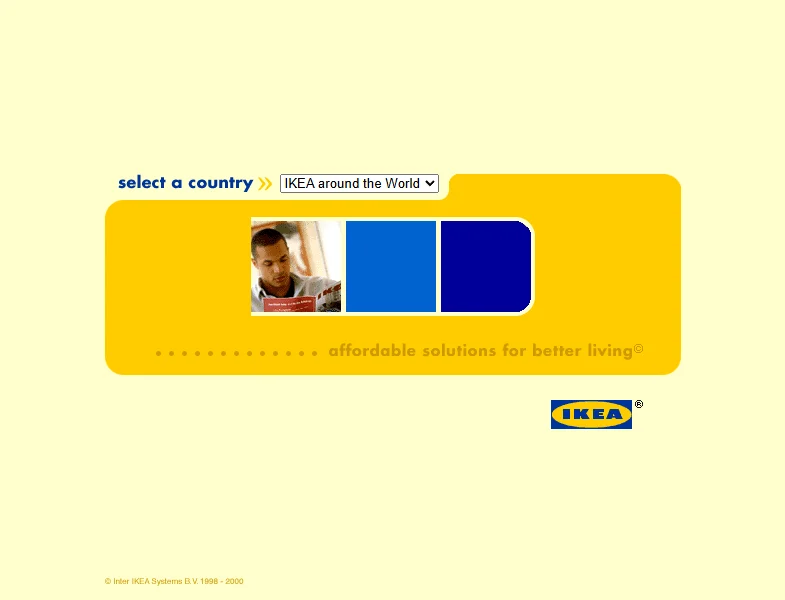
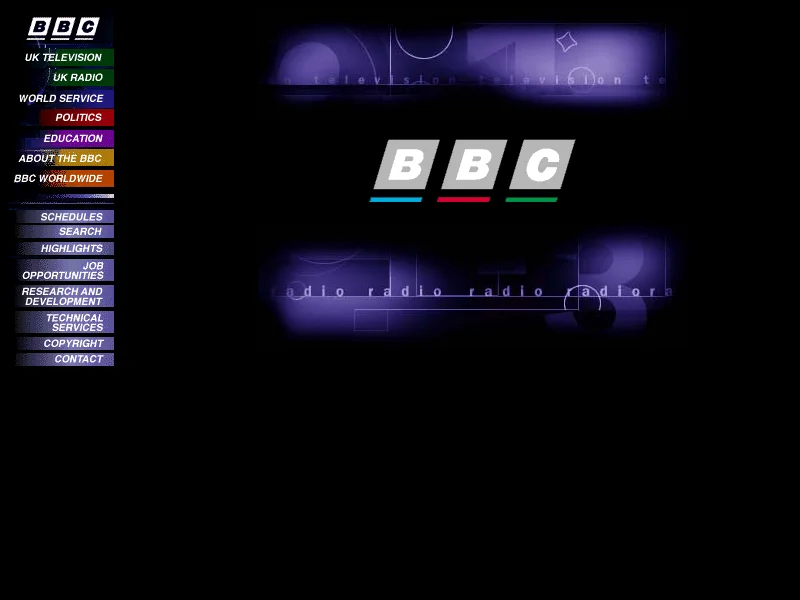
IKEA’s first website went online in 1997, and nothing could be bought on it: online orders started in the United States in 2001. The copy from December 1998 is a pale yellow page with one drop-down to select a country, listing seven country sites and the stores in about 30 countries. The New York Times went online on 22 January 1996 as “The New York Times on the Web”, and the first copy in the Archive, from November 1996, is not a front page but a registration page. The BBC’s homepage in April 1997 was a black page with a column of buttons for television, radio, the World Service and news.
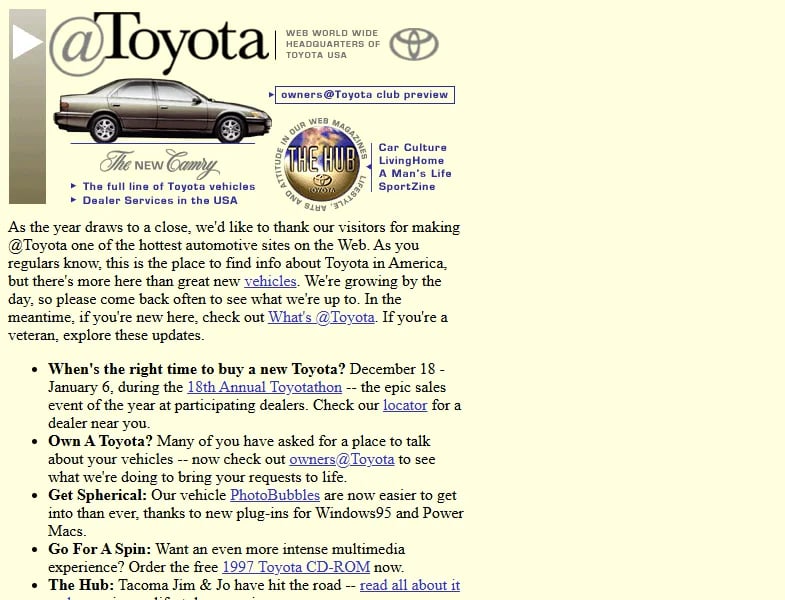
Toyota, 1996: a Christmas letter to visitors.Internet Archive, 24 Dec 1996 
BMW, 1996: “Please use NetScape 1.1 or 1.2”.Internet Archive, 30 Oct 1996 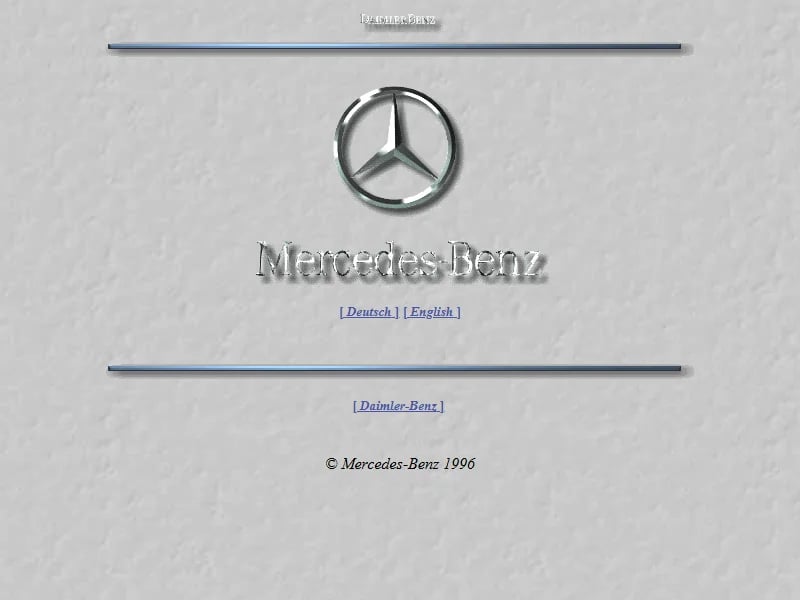
Mercedes-Benz, 1996: a star and a choice of language.Internet Archive, 10 Nov 1996 
Nokia, 1996: a corporate site, last modified 16 December.Internet Archive, 19 Dec 1996 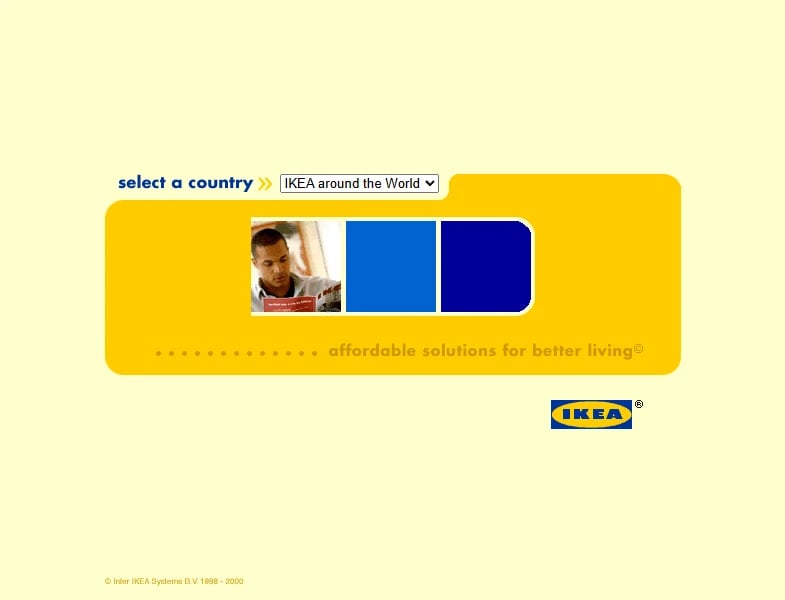
IKEA, 1998: pick a country; nothing to buy.Internet Archive, 12 Dec 1998 
The New York Times, 1996: register first.Internet Archive, 12 Nov 1996 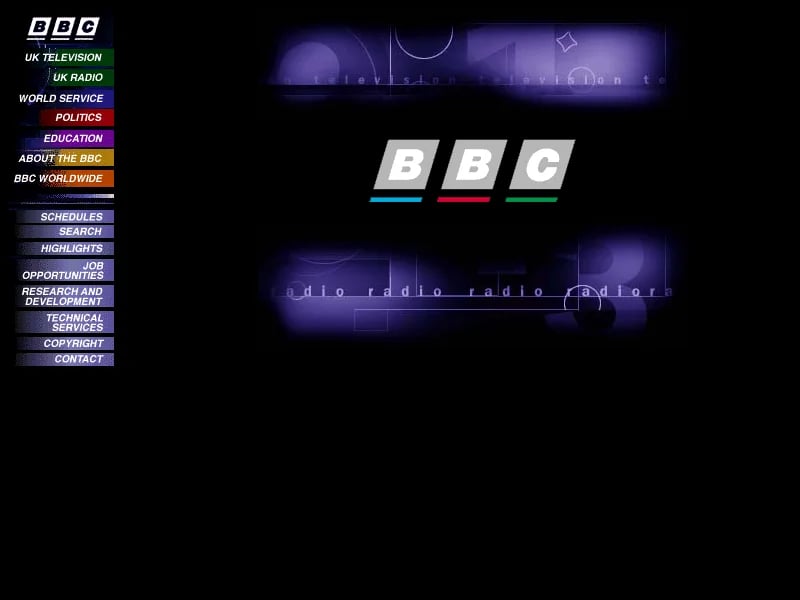
BBC, 1997: a column of buttons.Internet Archive, 28 Apr 1997


What the first homepages had in common
They welcomed you. “Welcome to Apple”, “Welcome to Pepsi World”, “Welcome to @Toyota”, “Welcome to eBay!”: the first line of a 1990s homepage greeted the visitor, because arriving at a company’s website was still an event. Several then asked you to click an image to enter the site, which is why Coca-Cola’s earliest copy from 1996 is a single picture and the words “Want more? Click the image.”
They told you which browser to use. BMW asked for a version of Netscape, Microsoft for Internet Explorer, adidas linked to Netscape’s download page and Pepsi to Shockwave, and the German Volkswagen site of 1997 told visitors with an older browser that their software was out of date. They were built from images: most navigation was a picture with clickable areas, and when an image was not saved, the menu went with it. That is why some copies in the Archive show broken image icons where the menu was.
They also had little to do. Only a handful sold anything online, mostly the companies that were born on the web. Most brands put up a homepage because they were expected to have one, and the job of a homepage came later: telling a visitor in one screen what the company does and what to do next.
What changed, and what did not
Almost every homepage became a shop or an app. Amazon, Apple, LEGO, IKEA and adidas now sell their whole range on their sites, Pizza Hut and McDonald’s take orders and track them, and Netflix, YouTube and Facebook show a log-in page and then an endless feed. The welcome text, the country list and the request to click an image have gone. So has the light weight: Google’s homepage in 1998 was one small logo and a form.
Two homepages barely changed. Google still opens on a logo and one search box, and Wikipedia’s portal is still a search box and a list of languages. Both serve one task that the visitor already came to do, and both have kept the first screen for it. The homepages that lasted longest are the ones with one clear job.
What this means for a website built today
A 1996 homepage could get away with welcoming you and asking you to click, because nobody had anywhere better to be. A visitor today decides in the first screen whether to stay, so that screen has to say what you do, for whom, and what to do next: call, book, buy or ask for a price. The welcome line and the logo that fills the screen are 1996 habits.
The other lesson is to keep a copy. Microsoft had to rebuild its own first homepage, and most of the brands above can only show theirs because the Internet Archive happened to visit. Before a redesign, save the old site, its texts and its addresses, and redirect the old pages to the new ones so that the links built up over years still work. Our list of the worst redesigns shows what happens when a new design forgets what the old one was doing well, and the history of the web covers how the pages above came to look the way they did.
— FAQ
Frequently asked questions
Sources and method
Each homepage was found with the Wayback Machine’s capture index, which lists every saved copy of an address, and the earliest copy that shows a real homepage was opened and read. The screenshots were taken by us on 14 November 2026 from those archived copies, at the screen sizes of the period (800 × 600 pixels for the 1990s, 1024 × 768 from 2001), and each one links to the capture it shows. Images the Archive never saved are left blank, and Flash content, which no browser plays today, is hidden. The homepages remain the property of their owners and are shown here for history and commentary. Launch dates and figures come from the sources below; quotes come from the captures themselves.
- Internet Archive — Wayback Machine ↗
Every capture on this page; each screenshot links to its own.
- Internet Archive — Wayback Machine general information ↗
The Archive began collecting the web in 1996.
- Matthew Gray, MIT — Web growth summary ↗
130 websites in June 1993, about 100,000 in January 1996.
- Wikipedia — Wayback Machine ↗
Opened to the public on 24 October 2001.
- Creative Bloq — How Microsoft’s 1994 homepage was rebuilt ↗
The 2014 reconstruction of the lost first homepage.
- Microsoft — the 1994 homepage, rebuilt in 2014 ↗
The reconstruction itself.
- Computing History — Yahoo founded, January 1994 ↗
“Jerry and David’s Guide to the World Wide Web”.
- History.com — Amazon opens for business (16 July 1995) ↗
Opening date and the first months.
- Business Insider — Amazon launched 30 years ago with one product ↗
All 50 states and 45 other countries in the first two months.
- TIME — The first item sold on eBay ↗
AuctionWeb, September 1995, and the $14.83 laser pointer.
- Quartz — Early images of Netflix.com ↗
Launch in April 1998 with about 925 titles.
- History of the Web — PizzaNet ↗
The 1994 pilot with The Santa Cruz Operation.
- Interesting People mailing list — PizzaNet announcement (August 1994) ↗
The announcement as it was sent at the time.
- QSR Magazine — Pizza Hut celebrates 20 years of online ordering ↗
Pizza Hut’s own “first online purchase” claim.
- The Next Web — The first e-commerce transaction was a Sting CD (2015) ↗
NetMarket’s card payment on 11 August 1994, the rival claim.
- Microsoft — Electronic commerce trend shows rapid growth (7 December 1998) ↗
Starbucks’ first online store, Christmas 1998.
- The Motley Fool — Why did Starbucks shut down its online store? (2017) ↗
The store’s closure.
- History Hit — Facebook is founded (4 February 2004) ↗
Launch date and the purchase of facebook.com for $200,000.
- FOX 9 — YouTube’s first video, “Me at the zoo” ↗
Domain activated 14 February 2005, first video 23 April 2005.
- MediaVillage — YouTube’s origin story, from dating site to video giant ↗
The video dating idea.
- History.com — Twitter launches (15 July 2006) ↗
The first tweet and the public launch.
- TIME — A history of Wikipedia ↗
Launch on 15 January 2001.
- The Next Web — Spotify, the story so far ↗
Public launch on 7 October 2008.
- Business Standard — The cola comfort on the web (1996) ↗
Pepsi World and the plug-ins it needed.
- The Brothers Brick — LEGO.com celebrates its 20th anniversary ↗
LEGO.com went live on 23 March 1996.
- The Walt Disney Company — The evolution of Disney.com ↗
Disney.com’s launch in 1996.
- IKEA Museum — IKEA.com ↗
The first website in 1997 and online sales from 2001.
- The Auto Channel — Toyota press release (December 2000) ↗
Toyota’s US site, launched in 1995.
- Nieman Lab — 20 years ago today, nytimes.com debuted ↗
22 January 1996.
- journalism.co.uk — 20 years of digital milestones at BBC Online ↗
BBC Online’s official launch in 1997.
- Internet Archive — Terms of use ↗
Access for scholarship and research; the Archive asks to be credited.
Is your homepage still saying “welcome”?
We redesign homepages so the first screen says what you do and what to do next, and we keep your old pages, texts and links working when the new site goes live.